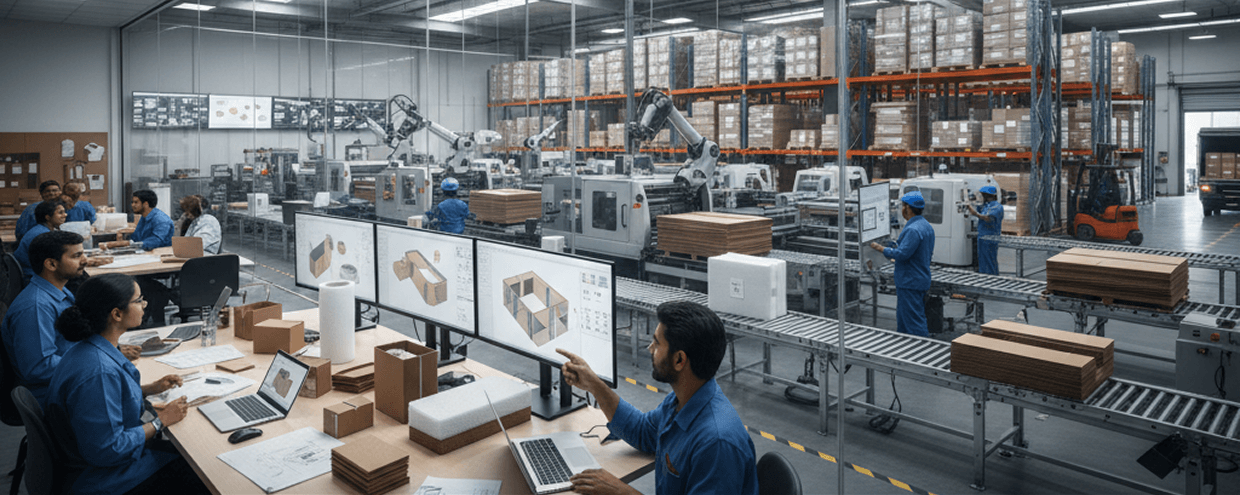

Introduction: When Packaging Stops Being “Just Packaging”
Most manufacturers don’t lose money because their packaging is weak. They lose money because it’s under-strategised.
Freight inefficiencies that go unnoticed. Repetitive transit damage absorbed as “operational cost”. Excess warehouse space is consumed by inefficient formats. Packaging that protects the product but quietly inflates total landed cost. On paper, everything works. Orders are fulfilled. Materials arrive. Production moves. But packaging decisions made purely at the procurement stage rarely optimise the system they enter.
At scale, that gap becomes expensive. This is where the distinction between a packaging supplier and a packaging partner becomes more than terminology. One delivers against a specification. The other challenges it and improves what sits behind it. For manufacturers focused on resilience, efficiency, and long-term scalability, that difference directly impacts performance.
The Transactional Supplier: Order In, Order Out
A packaging supplier operates within defined specifications. Their role is to deliver what is requested, no more, no less.
You provide drawings, dimensions, load expectations, and quantity forecasts. They calculate cost, confirm timelines, and execute production. Their competitive advantage lies in pricing efficiency, material consistency, and dispatch reliability.
The relationship is typically vendor-list driven. If another supplier offers a lower quote or faster turnaround, substitution is straightforward. Engagement is reactive. Interaction is largely confined to purchase cycles.
In this framework, packaging is viewed as a cost centre. It is something to be controlled and optimised in isolation from broader operational strategy.
There is nothing inherently flawed in this model. It serves a purpose. But it stops at supply.
It does not question whether the packaging design is increasing freight inefficiencies. It does not evaluate pallet utilisation ratios. It does not analyse repetitive damage patterns during transit. It does not assess whether the storage footprint could be reduced. It does not influence packaging architecture before production scales.
It delivers packaging. It does not engineer impact.
The Strategic Packaging Partner: Designing for System Performance
A packaging partner enters the equation earlier and thinks more broadly.
Instead of merely responding to specifications, a partner seeks to understand the product, its movement, and its environment.
How is it handled on the shop floor?
How frequently is it loaded and unloaded?
What are the vibration patterns during transit?
How efficiently does it stack within a container?
Where are recurring damage points appearing in the supply chain?
These questions shift the conversation from “What box do you need?” to “What operational outcome are you trying to achieve?”
A strategic packaging partner looks beyond material supply and focuses on total cost implications. They consider freight optimisation, container fill rates, storage density, handling cycles, and sustainability goals. They may recommend structural redesigns that reduce material usage while maintaining strength. They may alter internal cushioning systems to prevent transit damage. They may streamline packaging formats to align with just-in-time production schedules.
Over time, this involvement integrates them into the operational fabric of the business. They influence packaging decisions before tooling is finalised and before inefficiencies become embedded in the supply chain.
This kind of relationship is not easily replaceable, because its value is not confined to price per unit. It lies in risk reduction, cost optimisation, and long-term efficiency.
Packaging, in this context, transforms from a purchased product into a strategic asset.
Transactional Engagement vs Strategic Involvement
The contrast between a supplier and a partner is ultimately about depth of involvement.
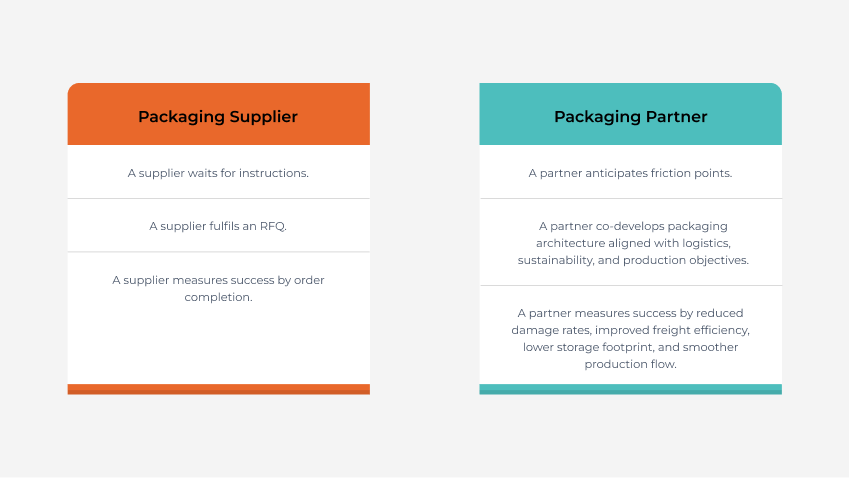
For manufacturers operating at scale, where minor inefficiencies multiply rapidly, this distinction directly influences profitability and resilience.
Honecore: Engineering Packaging as a System, Not a Commodity
The difference between a packaging supplier and a packaging partner is not theoretical. It is operational.
Honecore was built on the belief that industrial packaging should strengthen supply chains, not merely serve them.
For manufacturers in the appliance, automotive, and heavy industrial sectors, packaging cannot be treated as a commodity. It must be engineered around load behaviour, stacking pressure, transit stress, handling frequency, and freight optimisation. Every structural decision influences cost, risk, and efficiency downstream.
Honecore approaches packaging as a system, not as a product.
Using advanced paper honeycomb architecture, the focus is on delivering structural strength with material efficiency, reducing damage exposure, improving pallet and container utilisation, and aligning packaging formats with just-in-time production environments. Instead of reacting to specifications, Honecore works alongside manufacturing and R&D teams to refine them, often identifying improvements before inefficiencies scale.
This is not transactional supply. It is strategic involvement.
For manufacturers seeking measurable reductions in total packaging-related cost from freight and storage to damage and handling, Honecore operates as a long-term engineering partner, not a vendor on a list.

Final Thoughts: Beyond the Box
Packaging decisions shape more than outward protection. They influence freight cost, storage efficiency, operational flow, sustainability metrics, and long-term scalability.
When packaging is treated purely as a procurement function, its contribution remains limited. When it is approached strategically, it becomes a lever for operational improvement. For manufacturers navigating increasingly competitive and cost-sensitive markets, that distinction is not cosmetic. It is fundamental.
The choice is not simply between vendors. It is between transaction and transformation.