

Introduction
Achieving net zero is not a distant ideal. It has become a practical, long-term outcome when engineering-led thinking is applied across the entire value chain. Packaging, often dismissed as a peripheral cost, is in reality one of the most powerful and immediate levers for reducing emissions at scale. When organisations begin viewing packaging not as a mere protective layer but as an engineered system, its influence on sustainability performance, operational efficiency, and financial resilience becomes unmistakably clear.
Rethinking Packaging Beyond the Surface
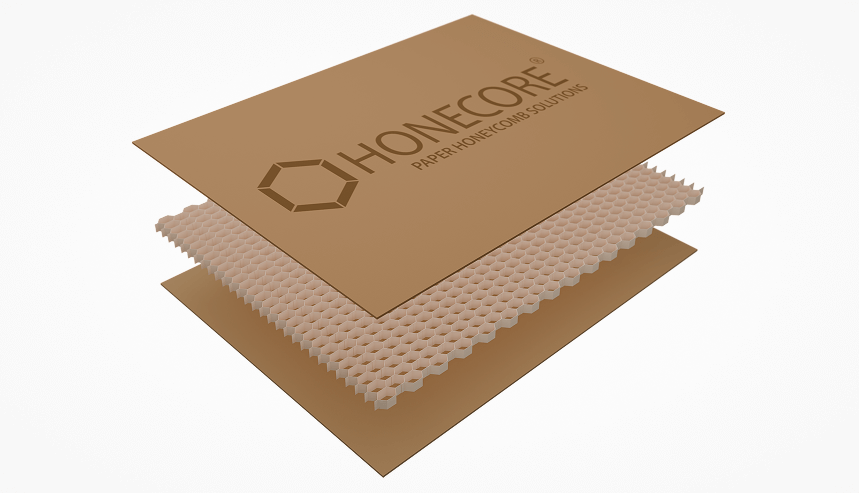
Packaging sits at the intersection of materials engineering, logistics, and product strategy. Its design and composition influence not only the carbon footprint of the product but also operational costs. While Scope 1 and Scope 2 emissions are frequently monitored, Scope 3 emissions (those generated along the supply chain), often constitute the largest share. Packaging choices can materially affect this footprint.
Reducing packaging weight, adopting recyclable materials, and engineering efficient designs directly lower transportation energy, cut raw material use, and simplify end-of-life management. For example, replacing traditional multi-layer plastics with recyclable kraft or mono-material solutions can reduce packaging weight by up to 20-30%, translating into substantial reductions in both logistics costs and carbon emissions.
Engineering-Led Optimisation

At Honecore, packaging is approached as an engineering challenge. Advanced material testing and structural analysis, and real world testing allow us to design packages that maintain durability while reducing material use. This approach does more than cut emissions, it also preserves product integrity, optimises storage, and enhances handling efficiency across the supply chain.
A 15% reduction in material for a product that is produced in millions of units each year can save hundreds of tonnes of raw material, a direct contributor to Scope 3 emission reduction. Beyond sustainability metrics, these savings improve cost efficiency and free capital for reinvestment in innovation.
The Ripple Effect on Operations and Reporting
Optimised packaging also simplifies broader operational and compliance considerations. Lighter and recyclable materials reduce shipping volume, fuel consumption, and storage requirements. Simultaneously, they streamline ESG reporting by providing more precise data on material flows and emissions reductions.
Furthermore, as regulatory frameworks tighten around packaging and waste, adopting sustainable packaging proactively mitigates future compliance risks. Early investment in circular, recyclable, and efficient materials often translates into avoided costs, lower supply chain disruption, and enhanced long-term resilience.
Innovation as a Sustainability Driver
The transformation of packaging is not limited to materials alone. Bio-based polymers, recyclable composites, and minimalistic designs are redefining what a package can achieve. By integrating these innovations with engineering-led design, companies can significantly lower material consumption while maintaining product protection and consumer appeal.
From a financial perspective, these investments are measurable. Reductions in raw material, logistics costs, and carbon emissions feed directly into ESG metrics and sustainability-linked financial instruments. In essence, packaging becomes a platform for both environmental impact and operational efficiency.
Connecting Strategy to Net-Zero
The journey to net-zero requires integrating sustainability into the core of business operations. Packaging, often considered a peripheral element, is in fact a strategic touchpoint. Engineering-led approaches reduce material usage, lower emissions, optimise logistics, and simplify reporting. Each of these factors compounds, contributing meaningfully to a company’s overall net-zero objectives.
In this context, the question is not whether packaging can contribute to net-zero goals, but how quickly organisations can leverage design, materials, and innovation to create measurable impact. By approaching packaging with the same discipline applied to product engineering or supply chain management, the environmental and financial benefits become tangible and mutually reinforcing.
Honecore: Your Packaging Partner
Honecore brings engineering precision into the heart of sustainable packaging, transforming it from a cost-driven necessity into a strategic enabler of net-zero progress. Through advanced simulations, structural optimisation, and material-efficient design, Honecore develops packaging solutions that use significantly less raw material while maintaining the required strength and performance.
This reduction directly lowers embedded carbon, improves logistics efficiency, and supports more accurate Scope 3 reporting. By offering recyclable, lightweight, and production-friendly alternatives, Honecore enables organisations to cut emissions without operational disruption, demonstrating how engineering-led packaging can deliver both environmental impact and long-term financial value.

Conclusion: The New Reality for Packaging
Sustainable packaging represents more than an environmental statement—it is a measurable, quantifiable lever to support net-zero ambitions. Through engineering-led material reduction, the adoption of recyclable solutions, and design optimisation, packaging can reduce carbon emissions, enhance operational efficiency, and strengthen long-term resilience.
Viewed strategically, packaging is no longer just a container for products, but a key component in building sustainable, financially responsible, and future-ready businesses. In pursuing net-zero, every gram saved, every recyclable material adopted, and every logistical improvement counts. The impact is tangible, measurable, and ultimately, essential.