
Introduction
Most industrial packaging materials are designed for performance during transit. Very few are engineered with equal attention to what happens after unloading. That is where circular value is either preserved or lost.
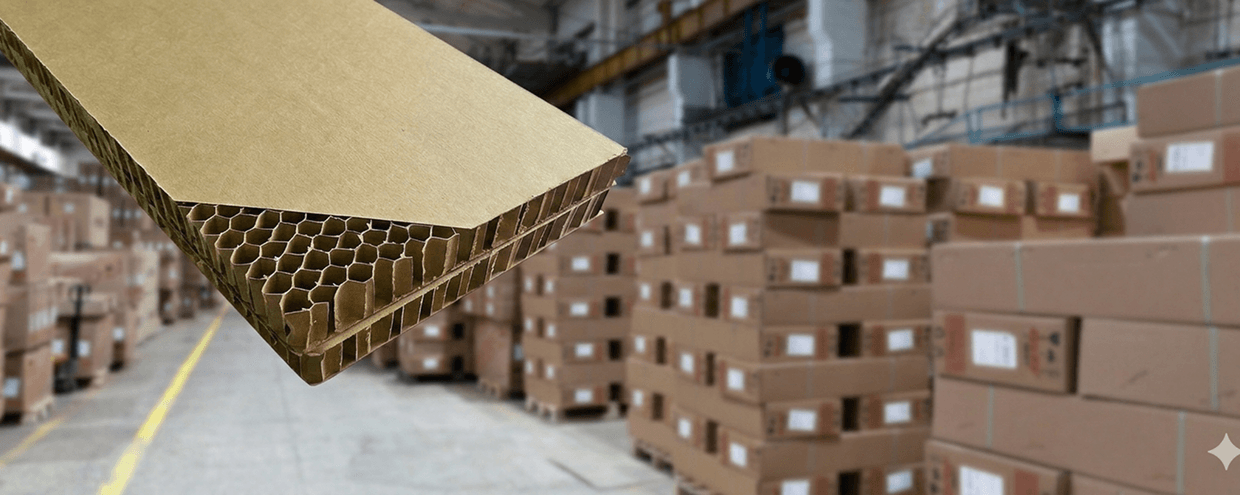
Paper honeycomb earns its place in circular manufacturing systems because its structural design and material composition are aligned with Kraft paper recovery from the outset. It uses geometry, not mixed materials, to achieve strength. Once its protective function is complete, it can be compacted and processed directly within established paper recycling streams without separation, contamination risk, or specialised handling.
Structural Intelligence at the Design Stage
Circular efficiency begins at material design. Honeycomb achieves high compressive strength through its hexagonal cell architecture. The geometry distributes vertical loads across bonded paper walls, allowing the structure to withstand stacking pressure without excessive material mass.
In practical applications from appliances to engineered assemblies, this means packaging can maintain rigidity under warehouse stacking and containerised export.
Lower material intensity directly reduces resource consumption per shipment. Strength is achieved through structure rather than added bulk. That efficiency at the design stage forms the first layer of circular contribution.
Lightweighting as a Resource Strategy
Material recovery is important, but resource optimisation during use is equally critical.
By replacing heavier substrates in protective packaging systems, honeycomb reduces total packaging weight. That weight reduction influences freight loading efficiency, handling energy, and overall material throughput across distribution networks.
Over repeated dispatch cycles, these incremental reductions compound. Less mass moves through transport systems. Fewer raw materials are consumed per unit of protection delivered. Circular systems depend not only on what happens after use but also on how intelligently materials are deployed before disposal.
Honeycomb addresses both.
Compatibility with Paper Recovery and Recycling Infrastructure
Circular materials must align with real-world recovery infrastructure. Paper honeycomb is manufactured from kraft paper formed into bonded core structures. Once unpacked at destination facilities, it can be compacted, baled, and processed within standard paper recycling systems.
There are no polymer laminations, no embedded foams, and no complex composite layers requiring separation. The material remains fundamentally paper-based, allowing it to enter established paper recovery streams without contamination complications.
This compatibility reduces rejection rates in recycling facilities and supports consistent paper regeneration.
In circular manufacturing ecosystems, alignment with existing processing infrastructure is often more important than novelty. Honeycomb integrates without disruption.
Regeneration Through Kraft Paper Continuity
Recovered kraft paper can be reprocessed multiple times before its structural integrity diminishes. Honeycomb structures contribute to this kraft paper pool without introducing incompatible additives that compromise regeneration.
Because structural strength is derived from geometry rather than synthetic reinforcement, the material retains its recyclability throughout its lifecycle. Industrial packaging volumes are substantial. When materials are compatible with regeneration systems at scale, the cumulative environmental benefit becomes measurable across supply chains.
Circular performance is strengthened by material continuity, and honeycomb maintains that continuity.
Practical Circularity in Industrial Supply Chains
Manufacturing environments prioritise reliability and efficiency. Packaging must protect high-value goods through handling, stacking, and transport. Once its function is complete, it must exit the system without creating secondary waste management challenges.
Honeycomb aligns with this operational rhythm. It delivers structural stability during active logistics cycles. After unpacking, it transitions directly into kraft paper recovery streams managed by existing waste collection networks. No specialised handling protocols are required.
Circular economy principles succeed in industry when materials support both performance and recovery without adding operational burden. Honeycomb does exactly that.
Honecore: Engineering Circularity at Scale
In the circular economy, impact is determined not by visibility but by volume and consistency. Honecore operates at that scale. By engineering paper honeycomb systems that combine structural efficiency with clean paper kraft recovery compatibility, the company embeds circular principles directly into industrial packaging architecture. Material selection, core configuration, and bonding systems are designed to maintain performance integrity during transit while ensuring seamless reintegration into established recycling streams after use.
At high dispatch volumes across appliance, automotive, and engineered goods sectors, this disciplined material design translates into measurable paper kraft regeneration and reduced material intensity. In practical terms, Honecore does not participate in the circular economy symbolically; it enables it through structurally intelligent packaging deployed at an industrial scale.

Conclusion: Designed for the Full Lifecycle
In the end, the smartest solutions are the ones that move the system and the environment. They protect without excess and leave without complication. They do their job quietly, efficiently, and completely. That’s the kind of thinking modern supply chains demand. And that’s the standard Honecore build for.